The AI Factory is no longer a conceptual blueprint; it is the current reality of hyperscale infrastructure. As large language models (LLMs) grow in complexity, the underlying network must evolve from merely “connecting servers” to becoming a seamless, high-bandwidth backplane for massive GPU clusters.
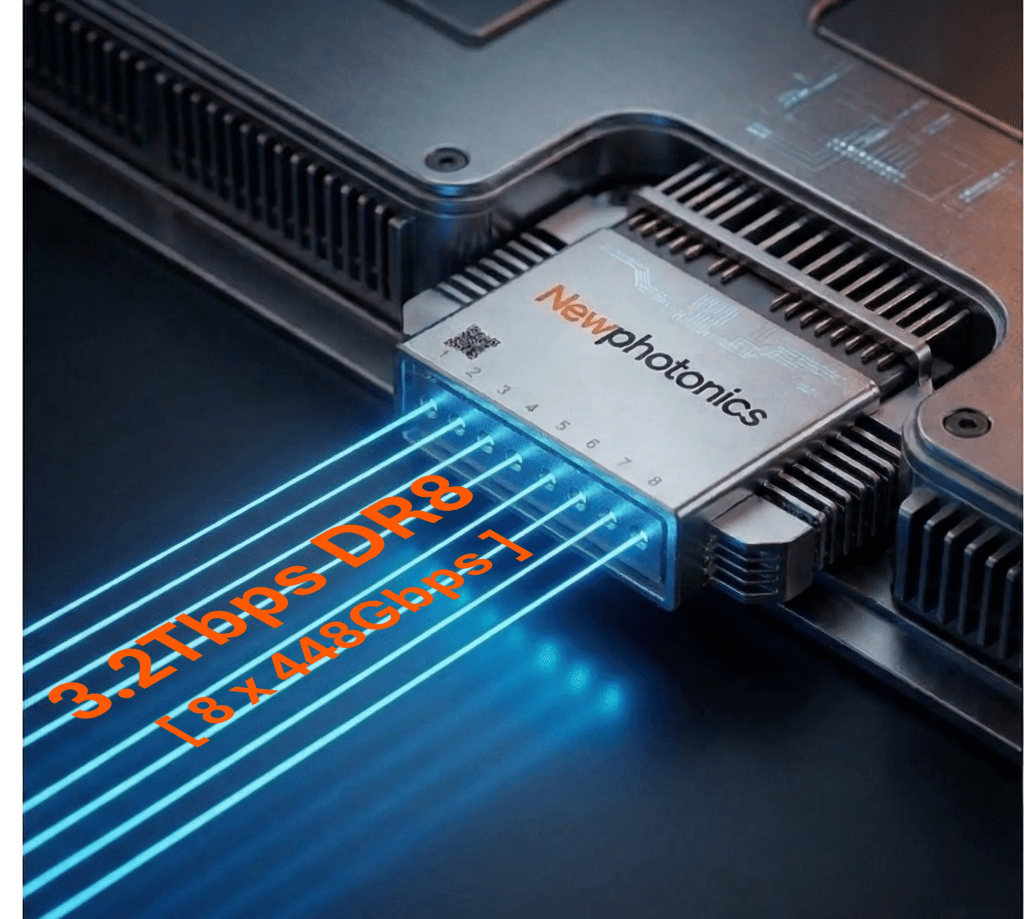
Today, NewPhotonics announced a major leap in this evolution: NPG10240, the industry’s first 3.2Tbps DR8 448G/Lane Transmitter-on-Chip PIC.
The 448G Breakthrough: Why 3.2T Matters
The transition from 800G and 1.6T to 3.2T is being compressed by the sheer velocity of AI compute demands. To keep pace with next-generation switches and accelerators, the industry is making moves to scale to 448Gbps per lane speeds.
At these frequencies, traditional copper interconnects and even standard optical designs face a power wall and significant signal integrity challenges. The NPG10240 addresses these challenges by incorporating in to the PIC:
- 448Gbps Modulators: Doubling the lane rate to achieve 3.2T aggregate bandwidth.
- OSPic™ (Optical Signal Processor): Our proprietary engine that handles signal equalization in the optical domain.
- Heterogeneous Laser Integration: Placing the light source directly on the PIC to reduce coupling losses and power consumption.
Solving the Interconnect Bottleneck for AI-Era Hyperscalers
Hyperscalers are currently re-architecting their data centers to support scale-up and scale-out topologies. This requires high-density solutions that can fit into both traditional pluggable form factors and Near-Package Optics (NPO) architectures.
“AI clusters are rapidly driving the transition to higher-speed optical interconnects… Highly integrated photonic engines will play an important role in enabling these higher data rates while maintaining power efficiency.”
— Vlad Kozlov, Founder, LightCounting
By processing electrical impairments directly in the optical domain via our OSPic™ optical signal processor technology, we reduce the heavy lifting required by the electrical DSP. This all-optical perspective on innovating connectivity in the optical domain relaxes RF design constraints to deliver critical sustainability metrics for AI including consistent link performance and significantly lower power-per-bit.
Enabling Practical Integration with Gearbox DSP
With the introduction of the Broadcom Tomahawk 6 and the Nvida Rubin Vera generation GPUs that both push 200Gbps per lane architectures, pluggable OSFP will increasingly rely on gearbox DSP architectures to translate between electrical and optical signaling domains into higher rate with lower fiber count. Integrating a 3.2T optical engine alongside these 448Gbps per lane DSPs requires careful attention to power, thermal density and signal integrity.
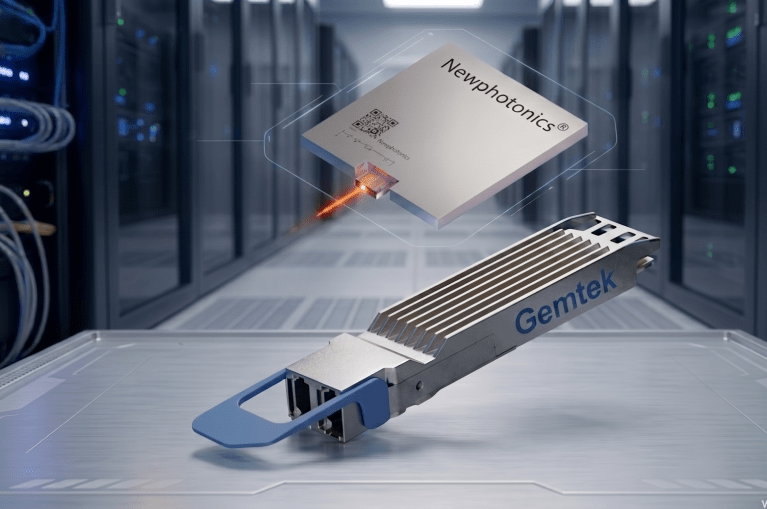
The NPG10240 simplifies this integration through a highly compact architecture combining 448Gbps modulators, integrated lasers and optical equalization within a single flip-chip photonic engine. This approach reduces external component count and enables more efficient electrical-to-optical coupling within OSFP form factors.
A Path Toward Near-Package Optics
Beyond pluggable optics, this level of integration opens a pragmatic door to NPO architecture development. As AI clusters scale, bringing optical engines closer to switch GPUs, accelerator and switching ASICs designed with 448gbps per lane SerDes becomes essential for managing power and signal integrity. Highly integrated PIC transmitters like the NPG10240 provide a practical path toward that transition.
Key Advantages of the NPG10240
| Feature | Impact on AI Infrastructure |
| 3.2T Aggregate Bandwidth | Enables massive throughput for GPU-to-GPU communication |
| Integrated OSPic™ Engine | Mitigates RF impairments, improving signal integrity at 448G |
| On-Chip Laser Integration | Simplifies supply chains and reduces assembly complexity for OEMs |
| Flip-Chip Packaging | Increases manufacturing yield and long-term reliability in the field |
Looking Ahead: Sampling in Q4 2026
The NPG10240 isn’t just a component; it’s a catalyst for the next generation of AI infrastructure. By removing the barriers to 448G/lane optics, NewPhotonics is ensuring that the network remains an enabler—rather than a bottleneck—for the future of compute.
Ready to discover a future with advanced optical interconnect?
Explore our Solutions Page to discover the breadth of our breakthrough approach to optical domain innovation for the future of pluggables and CPO.