Why inference and scale-up networking, not model access, is the next battleground for deployed AI advantage
Events of the past few weeks suggest that the AI industry tendency to frame leadership based on the race to the newest, largest, and most capable model is being replaced by a more nuanced definition of winner.
How?
A new frontline will be infrastructure performance and its effect on outcomes, not model characteristics alone, that decides which model is a true market success.
Two recent signals by major AI leaders stand out as important flags. First, Anthropic confirmed it was suspending access to Fable 5 and Mythos 5 following a U.S. government directive. Then, OpenAI deferred the public rollout of GPT-5.6. Read together, these highlight a new world where access to the most advanced frontier models is no longer automatic. It can be gated, delayed, or restricted by policy as much as by capability. Links to these recent announcements and the technology referenced are included at the end of this post.
Building Beyond the AI Model
If frontier access becomes gated, a new form of AI infrastructure asymmetry emerges. A controlled knowledge class made up of a small set of governments, trusted institutions, strategic enterprises, and approved infrastructure partners would derive the most advanced models first and compound an already unfair advantage.
Setting aside for now the important ethical implications, from an infrastructure perspective the takeaway is sharp: model access is only one tier of AI advantage. The ability to deploy, scale and economically operate those models is an equally important layer.
As a company leading innovation that enables the next layer, we view the ability to deploy, scale, and economically operate the model as just as vital as open model access. The strides made with optical interconnect innovation to reduce power consumption, increase bandwidth efficiency, and improve networking performance prove its vitality in the overall fabric dimension of AI infrastructure.
Why Connectivity Matters for Model Maturity
Here is why the current race to model leadership no longer matters without a broader value of connectivity for delivering intelligent model output. When open accessibility of the best models is constrained, those outside the class of use will react rationally by pushing their models in use much harder through inference scaling to achieve longer and smarter reasoning, agentic workflows, retrieval, verifiers, routing, and multi-pass execution.
Enterprises, sovereign clouds, CSPs and infrastructure companies turn to inference scaling, longer and smarter reasoning, agentic workflows, retrieval, verifiers, routing, and multi-pass execution to extract more intelligence from a fixed model. More reasoning means more sequential decode tokens, and decode is bound by memory bandwidth and KV-cache movement, not raw FLOPS. At scale it is bound by accelerator-to-accelerator bandwidth.
This constraint in moving bits shifts the entire definition of performance.
AI value becomes less about peak FLOPS and more about efficiency of useful reasoning delivered per watt, per dollar, per second and per rack. The model you run becomes less interesting than the throughput of intelligence you can sustain from it. As inference moves from single-pass token generation to multi-step reasoning workflows, the pressure lands squarely in the data path: memory bandwidth, accelerator-to-accelerator communication, scale-up fabrics, latency, power density, and thermal limits. Each added reasoning step multiplies the traffic crossing the fabric, so the interconnect, not the model, increasingly sets the ceiling on what a system can deliver.
Two architectural shifts make this acute. Sparse, mixture-of-experts inference turns every token into an all-to-all exchange across the accelerator domain. This is the most fabric-punishing pattern in the system. And disaggregated serving splits compute-bound prefill from memory-bound decode onto separate pools, streaming KV cache across the fabric by design. In both cases the model’s efficiency no longer lives in the chip. It lives in the interconnect.
Optical Interconnect in the Scale-Up Frontier
This is where optical connectivity becomes critical and where the distinction between scale-out and scale-up matters most. Scale-out is already optical. The frontier is in scale-up connectivity. Scale-up bandwidths run roughly an order of magnitude higher per accelerator on fabric that is still mostly copper. As accelerator domains grow past the rack, copper runs out of reach at 200G+ per lane. Even at short reach the energy per bit of electrical SerDes and re-timers becomes a dominant power and thermal problem.
The high-bandwidth scale-up fabric must go optical. That is the inflection point, and it is arriving on the same timeline as the inference workloads that demand it.
At the system level, inference is becoming a compute-fabric problem. The next leap in AI infrastructure will not come from any single component. It will instead come from co-optimizing inference ASICs, memory, networking, and optical connectivity together, because the roadmap keeps pushing in the same direction: higher bandwidth density, lower energy per bit, longer reach and more efficient scale-up and scale-out connectivity.
Doron Tal, NewPhotonics SVP & GM of Optical Connectivity
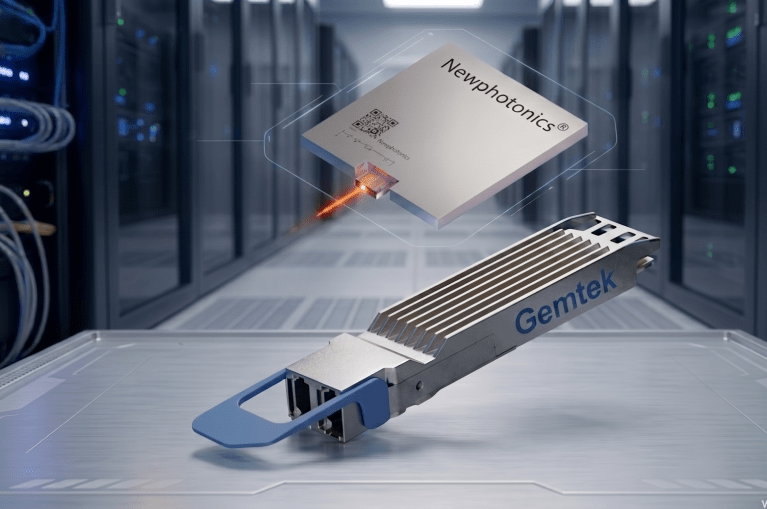
In practice this means bringing the optics in closer by integrating the engine with the package and the fabric rather than bolting a cable on at the end. In this formation, the link stops being the component that gives back the efficiency the rest of the system worked so hard to win. It is also why thermal headroom matters: heat keeps co-packaged optics out of the highest-density sockets and removing that barrier is what makes scale-up optical practical rather than theoretical.
So, scale-up optical connectivity should be viewed as an important part of the compute fabric, not just as a peripheral component. The winners in this next phase will be the builders of complete inference systems where ASICs, memory, software, networking, and optics are co-optimized to deliver deployed intelligence at scale.
That is the execution challenge and opportunity on the frontier of AI for all.
Learn more about NewPhotonics scale-up optical engine technology: We Broke the CPO Thermal Barrier: Introducing Syncra™ Heaterless Micro-Ring Modulator