Data centers worldwide are struggling to support on-demand AI model inference and training, primarily due to cost and power constraints. The demand for training AI models with billions of parameters and handling large-scale consumer interactions — from generative models to recommendation systems — has strained infrastructure and pushed the need for cost-effective and energy-efficient solutions. This has led to a reassessment of power management from the exploration of alternative energy sources to significant changes in optical transceiver design to address power dissipation concerns.
Notably, major companies like Amazon, Google, Microsoft, Meta and Oracle are securing nuclear power contracts to compensate for increased power demands and reappraising the value of extensive Digital Signal Processor (DSP) use.
In current high-speed connectivity configurations, there is an Application Specific Integrated Circuit (ASIC) in either the switch or Network Interface Card (NIC) as well as a local DSP in every transceiver that compensates for link degradation. Linear Drive Pluggable Optics (LPO) moves DSP functionality to the host, reassessing the need for it in the transceiver itself and significantly reducing transceiver power consumption.
However, this approach introduces new challenges, particularly regarding device interoperability and signal integrity. While LPO-based modules offer lower power and latency compared to retiming-based modules with discrete DSPs, they require careful attention to signal integrity, especially when ensuring compatibility across different vendors. Transimpedance Amplifier (TIA) and optical modulator driver chips in the transceiver cannot fully replace DSP capabilities to compensate for link degradation.
The limited equalization capabilities of TIAs and drivers are insufficient to effectively compensate for RF impairments introduced by design variations across different vendors. Consequently, the system cannot be optimized for the required Bit Error Rate (BER).
But the technical debate about LPO integration and co-existence with the current signal processing value chain can’t be a distraction from progress to resolve the vital barrier of energy efficiency. This is the basis of our integrated optical equalizer technology that is critical to delivering multi-vendor interoperability.
The Plus: LPO with Integrated Optical Equalization
We’ve pioneered novel techniques to advance Optical Signal Processing (OSP) across the data link. Our solution addresses vital performance gains as well as diminished signal losses at the Nyquist frequency.
The NPG102 for LPO-based modules – our LPO+ transmitter on chip – features a PIC that includes lasers, modulators, and equalizers integrated on monolithic silicon. Central to addressing multi-vendor networked infrastructure, the integrated optical equalizer enhances link interoperability performance for high-throughput optical interconnect.
Our innovative approach leverages programmable optical filters with optimized channel equalization capabilities, providing an advanced solution for mitigation of both RF and optical impairments in the communication link, hence enhancing signal fidelity. Using equalization capabilities of the programmable photonic filters, we are significantly improving the flatness of the channel transfer function by emphasizing the signal spectral components at the Nyquist frequency. The dynamic range of the programable optical filters is quite large and allows compensation of up to 12dB RF losses.
For example, measuring, Optical Modulation Amplitude (OMA), Transmitter and Dispersion Eye Closure Quaternary (TDECQ) and BER for 12dB RF loss channel performance we have shown gain at two orders of magnitude in BER as well as 5dB sensitivity improvement.
Each channel equalizer is independently programmable to amplify the high-frequency components of the incoming signal, effectively compensating for the low-pass characteristics of the physical medium.
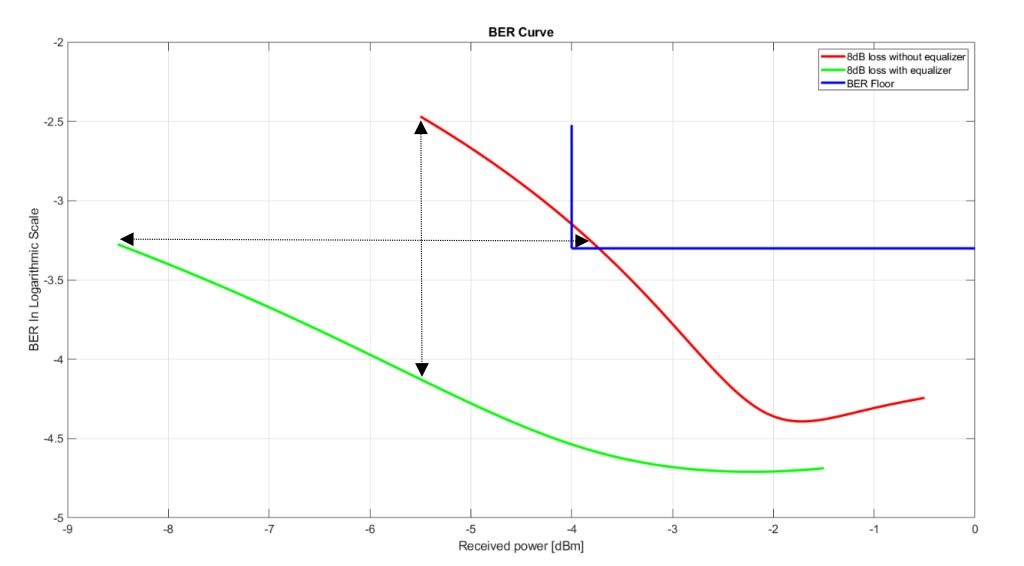
Figure 1: BER curves for 8dB RF loss with and without OSP
The integrated optical equalizer helps mitigate the effects of signal impairments such as bandwidth limitation and chromatic dispersion induced by the optical fiber, enhancing the overall signal transmission quality. The adaptive tuning capability achieved by the OSP enables consistent performance and interoperability.
Beyond signal optimization, the LPO transceiver module must also provide channel diagnostics to the host. This task is handled by the local DSP in conventional architectures but in LPO modules without a DSP, high-speed active diagnostic capability is not available inside the module. Instead, host ASIC capability is leveraged to provide metrics for the health of the link.
Our OSP based solution in tandem with other components (Driver, TIA, etc.) provide LPO MSA diagnostic requirement parameters to the module-based microprocessor which are subsequently passed on to the host ASIC. LPO+ firmware supports diagnostics including an indication of the signal presence, transmit optical power, output disable, as well as laser alarm and warning flags. The firmware is also capable of implementing corrective actions to optimize laser gain and wavelength tuning.
Higher level integration drives NP innovation
Linear pluggable optics adoption will make major strides this year as more hyperscalers and the data center infrastructure ecosystem clamor for optical interconnect solutions that expand network capabilities. In fact, in 2025 more wholesale consideration for adoption by the ecosystem will advance the ‘built for interop’ leap in technology out of necessity for AI-cluster driven data center transformation.
LPO with optical signal processing that significantly reduce power consumption and latency for 800Gbps and 1.6Tbps gained wide interest in 2024, but the urgency to address AI cluster compute and network performance gaps with integrated photonics now hinges on the critical need for interoperability along the connectivity network.
The LPO+ solution was built for interoperability from the ground up in line with our commitment to leading an all-optics paradigm shift in connectivity innovation with novel heterogeneous integrated lasers and a best-in-class transmitter design. With the debate resolving the question of ‘if’ for LPO as the next-gen path to advance interconnect with optical connectivity, it’s time to overcome the noise of limitations with the ‘plus’ approach to interconnect infrastructure in the new AI data center.