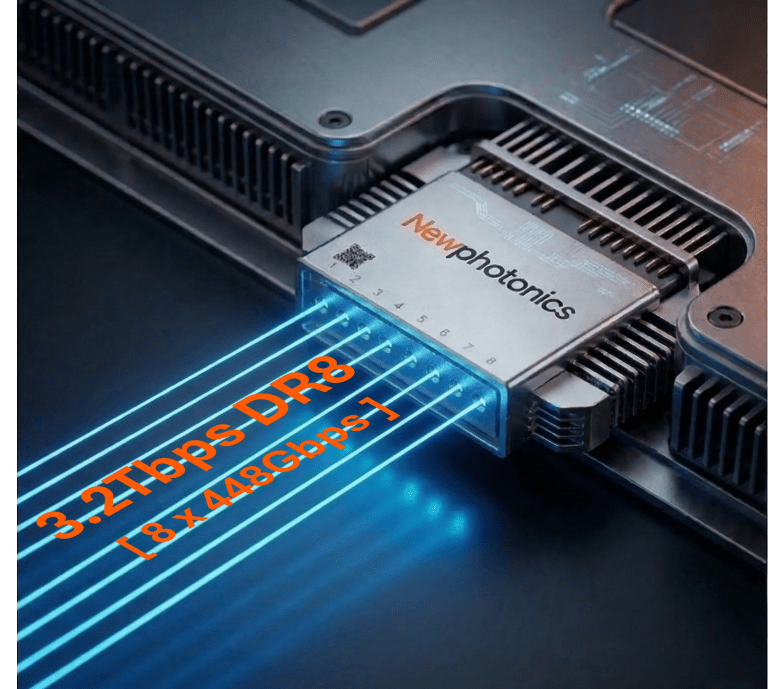
The race to evolve beyond the electrical limitations of Moore’s Law is on. All attention has turned to bringing complex new CPO systems to market that will maximize data consumption in more power-efficient data center infrastructure.
In the future, co-packaged optics will be the linchpin for AI factory expansion, from predominantly electrical to full-scale electro-optics. But AI isn’t waiting. Data centers need bandwidth and power efficiency to serve up the historic volume of artificial intelligence generated and demanded today, and it has to be scalable.
We’re taking a progressive approach to a serviceable laser-based solution: our product roadmap charts innovative technologies that address the complexity and market pressures characterized by demand-side speed and bandwidth expansion, alongside design-side requirements for a more energy efficient laser package. And we’re doing it without compromising reliability. The photonics-based data center is no longer a distant projection; we have designed silicon photonics chips to address the physical requirement for the AI factory right now.
At NewPhotonics, hyperscalers are discovering a pragmatic and partner-driven approach to high-bandwidth density at market-disrupting speed and power performance. While co-packaged optics continues along a path to maturity, we’ve introduced a near-packaged optics answer for the expanding data center need to meet AI driven demand. The NPC50503 1.6T NPO transmitter is designed to bridge the optical domain interconnect path from pluggable to CPO solutions in a more developed co-package ecosystem.
The Electrical Wall: Why We Must Move Closer to the ASIC
The standard, decades-old approach to data center networking can no longer rely solely on “front-panel” optics. In this model where digital electrical signals originate at the source (be it a GPU, Switch, or HPC processor), the high-speed data and performance expectations prevent it from efficient travel across the PCB to the front panel and through that standard OSFP module to converts the signal to optical – even for short versus long-haul transport.
The efficiency paradigm is starting to break now as speeds reach 200Gbps per lane and will cease to function entirely as we enter and go beyond the 400Gbps era. The physical distance the electrical signal must travel still matters, and as frequency increases, the “reach” of copper traces on a PCB continues to shrink. Maintaining signal integrity with greater data volumes at higher speeds even over a few inches is less and less effective – and certainly less energy efficient.
Rather than innovating to reduce power, contemporary architectures such as the addition of digital re-timers along the electrical path or replacing the PCB with direct copper cables simply preserve the existing state by utilizing high energy components and BOM cost that are not scalable.
While the CPO movement seeks to drive the E/O (electrical-to-optical) conversion point as close as possible to the ASIC to eliminate traces, moving directly from electrical to CPO introduces a new set of risks.
The NPO Advantage: Shortening the Stride to CPO
Near-packaged optics (NPO) represents a tactical evolution. By placing a pluggable optical engine with a socketed, near-packaged configuration, we achieve the signal integrity benefits of proximity without the reliability nightmares of full integration.
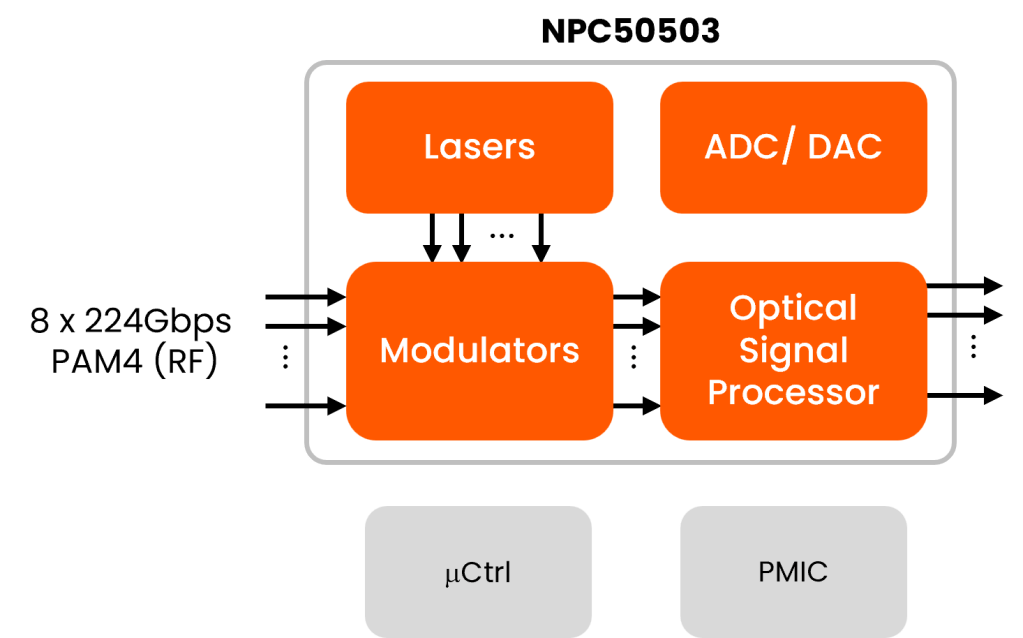
The pluggable market offered significant advantages in compatibility and serviceability that CPO is struggling to meet. Consider a misbehaving optical link: with a hot-pluggable OSFP, a technician can simply swap the module. Current CPO designs, however, are far more complex. It may take a field technician a full day to shut down a rack, access the tray, and disassemble the entire system to reach an integrated optical module—some of which are soldered directly to the board.
The NPC50503 changes this calculation. It fits a serviceable plug that sits close enough to the source to maintain electrical integrity while retaining the modular characteristics of an OSFP. And it provides 1.6T interoperability at performance beyond today’s LPO-MSA compliance standards. This allows hyperscalers to immediately improve power efficiency while gaining crucial operational experience with integrated optics.
Breaking Capacity and Energy Constraints
Every innovation cycle since the Industrial Revolution has driven a “bubble-like” conundrum. The early telecom bubble was driven by infrastructure overbuild; the handheld compute bubble was driven by cloud demand. Today, we are experiencing a shift from CPU to GPU hardware that has created massive demand with limited gains in energy efficiency.
We are now entering a decade where the shift from electrical to Optical is mandatory. The transition from a 90/10 electrical/optical architecture to an optical-dominated scale is evolving faster than the power capability of our physical infrastructure. Real estate and rack space are finite, and the energy required to turn on more capacity often exceeds the power limitations of the local grid.
Industry leaders like NVIDIA are proclaiming new performance targets for hardware at 5x power reductions and 10x higher resiliency. However, these leaps often focus on the “Giant Data Center” of the future. They don’t account for optimizing the infrastructure where AI is running now.
With an NPO solution, advanced optical signal processing can affect power reductions of 20%, freeing that power to increase compute accessibility in the 500GW data centers currently nearing completion.
Introducing The NPC50503 laser integrated transmitter with integrated OSPic™ all-optical signal processor
The heart of our innovation is the NPC50503 1.6T NPO laser integrated transmitter chiplet featuring our OSPic™ all-optical signal processor. Unlike traditional solutions that rely solely on DSPs to correct signal impairments, our engine performs these functions in the optical domain. This direct connection to the SerDes is crucial to avoid DSP power consumption.
Laser integration carries many advantages like simpler assembly process, lower part count and higher yield, but prior attempts to integrate lasers directly inside a switch package were perceived as a substantial reliability risk. A single laser failure would necessitate replacing an entire, expensive switch ASIC.
Our approach offers a progression toward CPO with our laser-integrated solution. We utilize a reliable, low-loss coupling modality that is swappable with simple access to the ASIC fiber interface. This eliminates the need for an External Laser Source (ELSFP), which is often bulky, expensive, and complex to manage.
Our integrated laser provides higher reliability, with known-good-die and eliminates the need for system-wide re-architecture.
The Serviceability Dilemma: Minimizing Light Failure Risk
For hyperscale data center architects, the lack of modularity in early CPO designs was a “non-starter.” The NPC Series introduces the first-tier opportunity to deploy serviceable optical modules in the switch without significant cost or uptime losses.
By applying the new paradigm of optical domain signal processing, the NPC50503 chiplet combats the largest power and latency culprits: DSP, CDR, and Electrical Equalization. A critical advantage of this power reduction is cooler run temperatures.
By reducing heat at the source, we lower the added power drain imposed by aggressive liquid cooling technologies, creating a “ripple effect” of efficiency across the entire rack.
Flexibility: Programmable Optical Equalization and Interoperability
In a multi-vendor environment, interoperability is the ultimate requirement. The NPC50503 leverages programmable, self-maintained optical filters with optimized channel equalization capabilities. This allows for the mitigation of both RF and optical impairments in the communication link, enhancing signal fidelity regardless of the hardware on the other end.
Using the equalization capabilities of our programmable photonic filters, we significantly improve the flatness of the channel transfer function. We emphasize the signal spectral components at the Nyquist frequency to compensate for up to 12dB of RF losses.
In measuring Optical Modulation Amplitude (OMA) and Transmitter and Dispersion Eye Closure Quaternary (TDECQ), we have shown a gain of two orders of magnitude in Bit Error Rate (BER) and a 5dB sensitivity improvement.
With the introduction of independent programmability, each channel equalizer is can be monitored and adjusted to amplify high-frequency components, effectively compensating for the low-pass characteristics of the physical medium.
Summary: Drawing Optics Closer to the Core with NPO
The NPO prologue hinges on the features we are introducing today. The NPC50503 enables a migration path from scale-out to scale-up networking with a fully integrated PIC-based platform that avoids wire bonding for cleaner production and higher signal integrity. That same laser integration eases the transition to Near-packaged solutions benefiting from both serviceability and lower power advantages.
For hyperscalers, NPO is a pragmatic bridge. The NPC50503 1.6T NPO transmitter recoups power consumption deficits while enabling speed and bandwidth density scaling in interoperable standard-compliance. It provides a way to cope with the immediate AI data explosion while laying down the groundwork for the resource planning and management of full-scale CPO.
The all-optical advantage is a future-proof alternative to waiting for full-stack CPO. The NPC50503 is a real-world solution with energy efficiency and deployability gains that provide a low-risk glimpse into subsequent degrees of scale.